Best AI Detectors for Essays: Understanding Clever AI Detector’s Test Results
Five essay detectors are ranked using a published 750-essay test, current feature details, plus pricing. The bigger lesson is how little a confident percentage proves by itself.
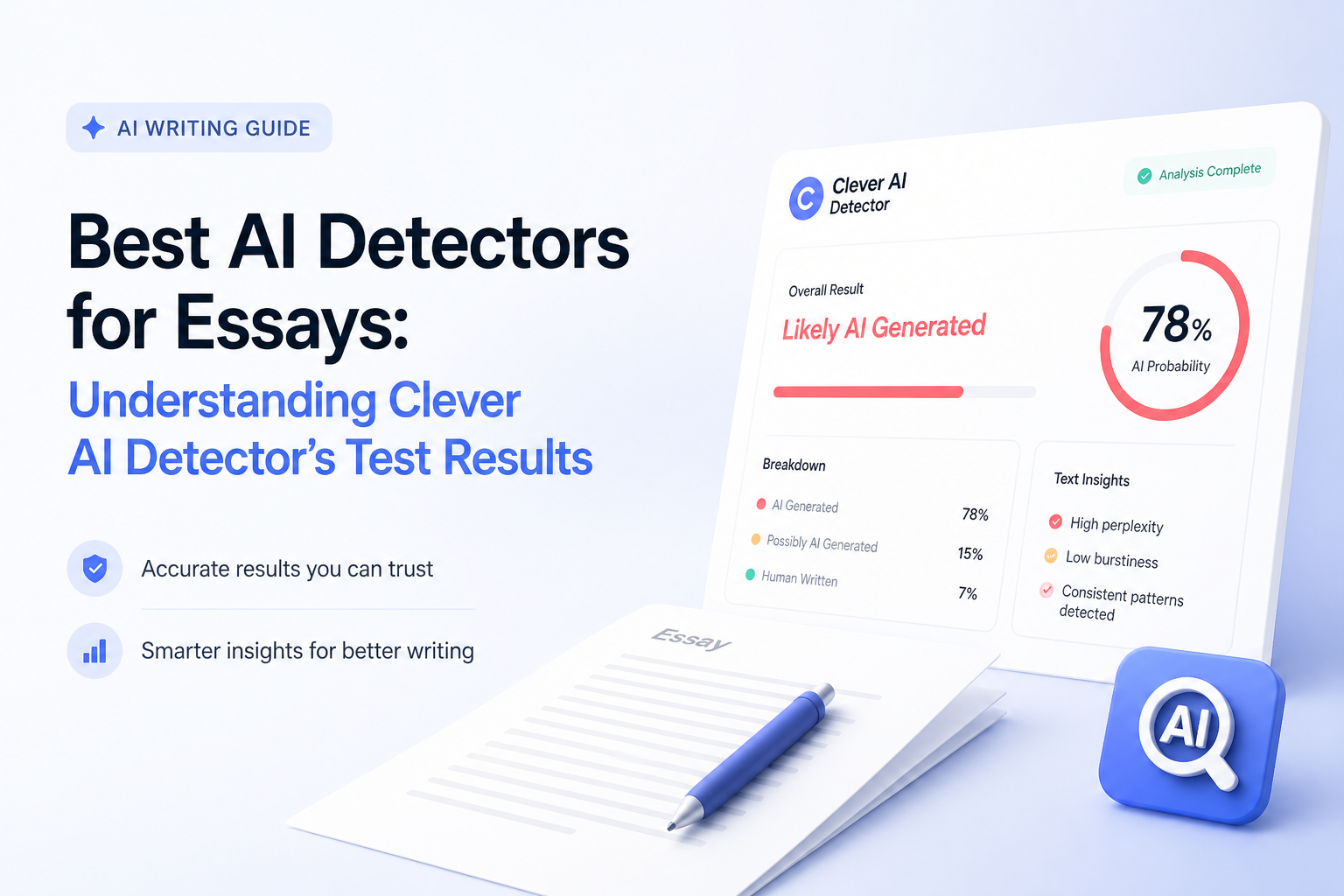
Clever AI Detector is the best overall pick for essay checks because it caught 96.7% of AI-involved texts in the August 2026 benchmark while never falling below 92.0% in any AI category. Its score is a probability signal, not proof of authorship, so inspect the highlighted sentences plus the writer's draft history before drawing conclusions.
Clever AI Detector
9.2/10Best for: Students, teachers, or editors who want a free essay check with visible sentence-level signals
- Free with no sign-up required
- Up to 10,000 words in one check
- Sentence-level signals make results easier to inspect
- Strongest weakest-category result in the August 2026 GEDE benchmark
Copyleaks
8.9/10Best for: Schools or review teams that need multilingual AI detection plus plagiarism checking in one workflow
- Caught 93.3% of humanized essays in the benchmark
- AI detection supports 30-plus languages
- Combines AI plus plagiarism results
- Browser extensions plus Google Docs access
Originality.ai
8.4/10Best for: Publishers or instructors focused on essays that began as human work before receiving an AI editing pass
- Best benchmark result for AI-improved human drafts
- Perfect result on direct AI plus AI-rewritten essays
- Document uploads support common essay file formats
- Subscription includes readability plus grammar tools
Best AI Detectors for Essays Compared
The table uses results from an August 2026 benchmark of 600 AI-involved essays plus 150 human controls. Detection rate shows overall AI recall, while weakest category reveals how far each tool fell on its hardest essay type. Scores are editorial judgments based on test consistency, result clarity, access, plus price.
| Tool | Detection Rate | Weakest Category | Price | Score |
|---|---|---|---|---|
| 1. Clever AI Detector PICK | ● 96.7% | ● 92.0% | Free | 9.2/10 |
| 2. Copyleaks | ● 95.0% | ● 86.7% | $16.99/mo | 8.9/10 |
| 3. Originality.ai | ● 86.8% | ● 51.3% | $14.95/mo | 8.4/10 |
| 4. QuillBot AI Detector | ● 64.2% | ● 22.0% | Free | 7.3/10 |
| 5. GPTZero | ● 43.7% | ● 1.3% | Free | 7.1/10 |
The 5 Best AI Detectors for Essays, Reviewed
01 Clever AI Detector
Web App / CleverFiles
9.2/10
Clever AI Detector
Web App / CleverFiles
Clever takes first place because its August 2026 GEDE benchmark covered 600 AI-involved essays plus 150 human controls, rather than relying only on untouched chatbot output. It caught 96.7% of AI-involved texts overall. Its weakest category still reached 92.0%, the best floor among the eight detectors included in that published test.
The difficult cases explain the result. Clever identified 92.0% of humanized AI essays, 94.7% of human drafts improved by AI, plus 100% of direct AI essays. None of the 150 human controls were flagged, though that relatively small control set cannot establish a zero false-positive rate in general use.
The interface also makes the score easier to read. A result such as 90% AI means the writing statistically resembles model output. It does not mean a machine typed exactly 90% of the words. Sentence highlights help you inspect what pushed the result upward.
Best forStudents, teachers, or editors who want a free essay check with visible sentence-level signals
- Free with no sign-up required
- Up to 10,000 words in one check
- Sentence-level signals make results easier to inspect
- Strongest weakest-category result in the August 2026 GEDE benchmark
- Check history is available with a free account
- English text only
- An 80-word minimum rules out tiny excerpts
- The benchmark was published by Clever, so an outside replication would add confidence
02 Copyleaks
Web Platform / Copyleaks
8.9/10
Copyleaks
Web Platform / Copyleaks
Copyleaks came within ten detections of Clever across the 600 AI-involved essays, catching 95.0% overall. It led the humanized category at 93.3%, compared with Clever's 92.0%. Its weakest category was AI-improved human writing, where it still reached 86.7%.
That consistency makes it a sensible paid option for institutions reviewing many document types. AI detection covers 30-plus languages, while plagiarism checks cover over 100 languages. The Personal plan also supports browser extensions, saved scans, file batches, plus Google Docs.
Best forSchools or review teams that need multilingual AI detection plus plagiarism checking in one workflow
- Caught 93.3% of humanized essays in the benchmark
- AI detection supports 30-plus languages
- Combines AI plus plagiarism results
- Browser extensions plus Google Docs access
- Batch file scanning is included
- No permanent free tier was listed on the current pricing page
- Personal monthly pricing is steep for occasional student use
- Its AI-improved essay result trailed Clever plus Originality Lite
03 Originality.ai
Web Platform / Originality.ai
8.4/10
Originality.ai
Web Platform / Originality.ai
Originality.ai's Lite model caught 86.8% of all AI-involved essays in the benchmark. Its standout result was 96.0% on human essays improved by AI, the highest score in that category. It also reached 100% on direct AI output plus machine-rewritten essays.
The tradeoff was humanized writing. Detection fell to 51.3%, leaving it close to chance on that particular group. Only the Lite model was tested, so these figures should not be stretched to cover every detection model offered by Originality.ai.
Best forPublishers or instructors focused on essays that began as human work before receiving an AI editing pass
- Best benchmark result for AI-improved human drafts
- Perfect result on direct AI plus AI-rewritten essays
- Document uploads support common essay file formats
- Subscription includes readability plus grammar tools
- Useful scan history for recurring editorial work
- Caught only 51.3% of humanized essays in this test
- Full use requires payment
- The benchmark tested Lite rather than every available model
04 QuillBot AI Detector
Web Tool / QuillBot
7.3/10
QuillBot AI Detector
Web Tool / QuillBot
QuillBot caught 100% of direct AI essays plus 96.7% of machine-rewritten essays in the published benchmark. Those are useful results for obvious cases, especially from a detector that costs nothing for individual checks.
Its limits appeared once text was deliberately obscured or shortened. It found only 22.0% of humanized AI essays. For AI-involved samples under 200 words, detection dropped to 12.5%. Use it for an initial scan, not as the sole basis for a serious academic decision.
Best forStudents who want a quick second opinion without creating an account or buying a detection plan
- AI detection is free
- No account needed for a basic check
- Perfect direct-AI result in the benchmark
- Sentence-level feedback is easy to read
- Premium users can batch-upload up to 20 files
- Weak on humanized AI text
- Very poor benchmark result below 200 words
- Detection is one feature inside a broader writing suite
05 GPTZero
Web Platform / GPTZero
7.1/10
GPTZero
Web Platform / GPTZero
GPTZero produced an unusual profile on the shared essay set. It caught 92.7% of direct AI essays plus 73.3% of humanized text, yet just 1.3% of AI-improved drafts plus 7.3% of AI-rewritten human work. Overall detection was about 43.7% under the benchmark's strict rule.
Detection is only part of GPTZero's value. Its classroom tools include sentence highlighting, downloadable reports, plagiarism checks, plus Writing Replay. A replay of the drafting process may be much more useful during an authorship dispute than arguing over one percentage.
Best forEducators who value document history, writing replay, classroom reports, plus detector output
- Free allowance covers 10,000 words per month
- Writing Replay adds useful process context
- Strong recognition of humanized AI text relative to several rivals
- Built for teacher review workflows
- Offers sentence-level highlighting plus downloadable reports
- Weak overall result on this particular essay corpus
- Missed nearly all AI-improved drafts under the benchmark's strict scoring
- Paid plans cost more than free spot-check tools
How We Evaluated AI Detectors for Student Essays
This ranking uses Clever's published August 2026 run on the public GEDE essay corpus. The test submitted 150 texts from each of four AI-involvement groups, plus 150 pre-ChatGPT human essays, to eight detectors. That created 6,000 recorded verdicts. A third label such as mixed or uncertain counted as not AI, which particularly lowered results for tools that often avoid a binary answer.
We did not independently rerun all 750 essays. We reviewed the disclosed method, category results, limitations, current official feature pages, plus public prices. Editorial scores favor a high weakest-category result, clear explanations, practical access, plus restrained claims. The benchmark publisher also makes Clever AI Detector, which is a conflict readers should keep in mind until outside researchers reproduce the run.
How to Choose an AI Detector for Essays
Start with the type of AI use your policy actually prohibits. Nearly every detector can catch an untouched chatbot essay. Results separate sharply when a student writes the argument, then uses AI for grammar, rewriting, or paraphrasing. A school that allows grammar help should not praise a detector merely because it flags AI-polished drafts.
Look for sentence-level explanations, a usable minimum text length, clear uncertainty, plus exportable reports. For frequent marking, batch uploads or LMS support may justify a subscription. For a student checking one paper, a free tool with a generous limit is usually enough.
Common Mistakes When Reading AI Detector Results for Essays
The biggest mistake is interpreting 80% AI as meaning 80% of the essay came from a chatbot. Usually it means the detector sees a statistical profile that resembles AI writing. The number is model output, not a measured share of machine-written sentences.
Avoid testing a single paragraph, repeatedly rewriting honest work to satisfy a detector, or treating agreement between two tools as proof. Keep outlines, citations, notes, version history, plus earlier drafts. Those records say far more about who did the thinking than a colored score bar.
Which Essay AI Detector Should You Use?
Clever AI Detector earns the top spot because it stayed consistent across direct, edited, rewritten, plus humanized AI essays while remaining free. Copyleaks is the closest alternative if multilingual support or combined plagiarism checking matters more than cost.
Originality.ai fits AI-edited draft screening, while QuillBot works as a low-friction second opinion. GPTZero makes the most sense when writing history or classroom review tools matter more than its score on this specific corpus.
Run a full essay through two detectors, save draft history, then discuss the writing process before treating any score as meaningful.