Clever AI Detector Review: Everything You Need to Know
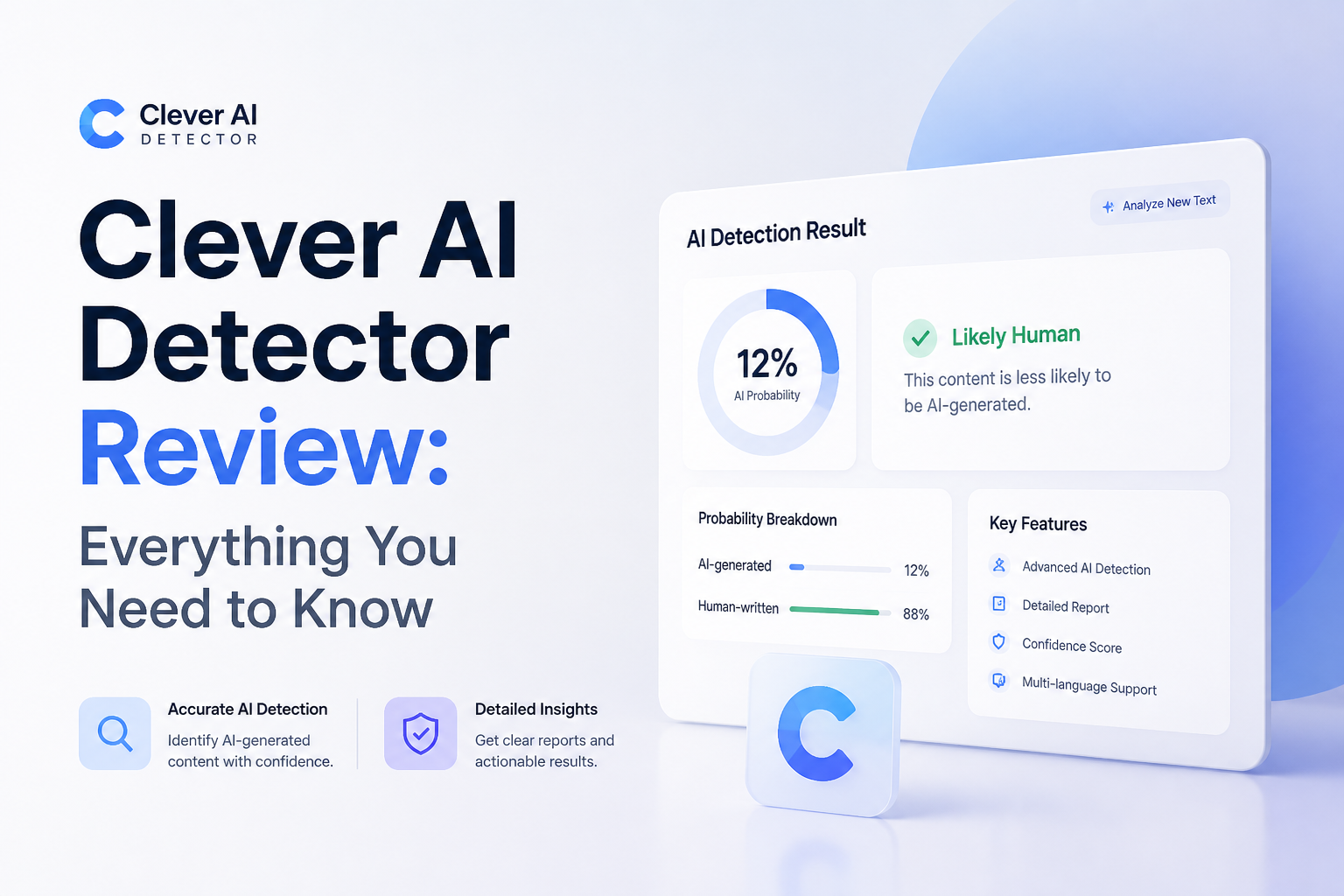
Clever AI Detector gives unusually detailed results for a free checker, including sentence-level signals plus confidence context. Its score is useful for screening, though it still cannot prove who wrote a passage.
Clever AI Detector is one of the most useful free checkers we tried. It accepts up to 10,000 words, marks suspicious sentences, requires no account, plus avoids pretending that its probability score proves authorship. Use it to spot passages worth reviewing, not to accuse a writer.
Clever AI Detector at a Glance
9.2/10Clever AI Detector is a browser-based checker that estimates whether English text resembles AI-generated writing. It returns an overall probability with sentence-level signals plus confidence context.
Best forEditors, writers, teachers, plus content teams needing a free preliminary screen
- AI probability score
- Sentence-level passage marking
- Up to 10,000 words per check
- Unlimited checks
- Optional check history
- Detailed report at no cost
- No account required
- Candid about false positives
- English-focused
- Cannot prove authorship
- Published benchmark is company-run
How We Tested Clever AI Detector for This Review
We checked the interface, input limits, report structure, sentence marking, account requirements, plus pricing as available in September 2026. Our sample set included unedited AI prose, human writing, machine-edited drafts, plus passages mixing both sources.
We also reviewed the company's August 2026 GEDE benchmark, its disclosed methodology, plus stated limitations. Detection performance received the most weight, followed by sentence-level usefulness, report clarity, routine workflow, then cost.
When Clever AI Detector Should Not Decide the Outcome
Do not use Clever AI Detector as the sole basis for accusing a student, employee, freelancer, or applicant of misconduct. Formal prose, heavily edited writing, templates, plus work by non-native English writers can produce misleading signals.
A fair review includes version history, notes, sources, earlier writing samples, plus a conversation with the writer. The detector can point you toward questions. It cannot tell you who sat at the keyboard.
Clever AI Detector Scores Across Five Review Categories
| Category | Performance | Score |
|---|---|---|
| 01 Detection Performance | 9.4/10 | |
| 02 Sentence-Level Analysis | 9.6/10 | |
| 03 Result Clarity | 9.1/10 | |
| 04 Everyday Workflow | 9.0/10 | |
| 05 Free Access | 9.8/10 |
Clever AI Detector Accuracy, Reports, Limits, Plus Cost in Detail
01 Detection Performance
Strong screening across several kinds of AI involvement
9.4/10
Detection Performance
Strong screening across several kinds of AI involvement
Clever AI Detector separated obvious machine output from natural writing well in our practical checks. It was most convincing on complete passages rather than tiny snippets, which matches the basic reality of statistical detection. More text gives the model more rhythm, phrasing, plus sentence patterns to inspect.
The company also published an August 2026 benchmark using 600 AI-involved essays plus 150 human controls from the public GEDE research corpus. Clever reported catching 96.7% of the AI-involved set, though this remains a company-run test rather than outside validation. The useful detail is that its weakest AI category still scored 92.0% in that particular run.
No score should be read as proof. A polished human report can resemble model output, while edited AI text can look natural enough to escape a flag.
- Handles raw, edited, rewritten, plus humanized AI text
- Shows uncertainty instead of claiming perfect accuracy
- Works better with substantial passages
- Published methodology includes test-set limitations
- The main public benchmark was run by the product's own company
- English academic essays do not represent every writing style
- A probability score cannot establish authorship
02 Sentence-Level Analysis
The most helpful part of the report
9.6/10
Sentence-Level Analysis
The most helpful part of the report
The overall percentage gets your attention, but the sentence markings are more useful. Clever points toward passages carrying stronger AI-like signals, so you can inspect a specific section rather than arguing over one number.
This worked particularly well with mixed drafts. A paragraph containing personal details, uneven sentence lengths, plus a generic summary produced a more nuanced report than a simple human-or-AI label. Still, a highlighted sentence is a clue about statistical style, not evidence that a chatbot wrote it.
- Highlights suspicious passages directly
- Makes mixed drafts easier to inspect
- Pairs the score with confidence information
- Useful for targeted editorial review
- Highlights do not explain every linguistic signal in depth
- Users may still overread red or strongly marked sentences
03 Result Clarity
Probability is presented as an estimate, not a conviction
9.1/10
Result Clarity
Probability is presented as an estimate, not a conviction
Clever makes a sensible distinction that several checkers muddy: an 80% AI probability does not mean 80% of the words came from AI. It means the passage's statistical profile resembles writing produced by a model.
The report is approachable without stripping away uncertainty. Scores near the center deserve caution, while a strong result is still only one piece of context. We would like a little more plain-language detail about why each sentence was marked, especially for editors reviewing unfamiliar subject matter.
- Explains the meaning of the probability score
- Includes a confidence layer
- Avoids absolute authorship claims
- Report can be copied for later review
- Some users may mistake probability for percentage of AI-written words
- Sentence explanations could include more detail
04 Everyday Workflow
Fast paste-and-check use with optional history
9.0/10
Everyday Workflow
Fast paste-and-check use with optional history
The basic routine is pleasantly short. Paste or upload a passage, run the check, then review the overall score plus marked sentences. No account is required for ordinary checks.
Each scan accepts between 80 plus 10,000 words. The lower bound discourages unreliable one-line tests, while the upper limit is enough for long reports, essays, or several article sections. Optional accounts add check history, which helps when comparing a draft before versus after revision.
- No signup needed for a standard check
- Supports pasted text plus file uploads
- 10,000-word ceiling suits long drafts
- Optional history helps track revisions
- Text under 80 words cannot be checked
- English is the clearly documented language
- No team review dashboard is advertised
05 Free Access
No paid tier hiding the useful report details
9.8/10
Free Access
No paid tier hiding the useful report details
The price is the easiest part of this review. Clever AI Detector costs $0, with unlimited runs subject to service availability. The probability score, confidence information, plus sentence-level signals are not reserved for subscribers.
There are no display ads or mandatory signup steps on the detector page. That makes it practical for occasional checks, repeated draft comparisons, plus people who do not want another monthly subscription. The company notes that its products may gain paid features later, so the current free model should not be treated as permanent.
- Full detector costs $0
- Unlimited checks are currently offered
- No ads or forced account creation
- Sentence signals are included for free
- Optional account history also costs $0
- The free model could change later
- Availability is not guaranteed
What Users Say About Clever AI Detector
One Reddit commenter described Clever as their regular detector for checking assignment drafts, with the completely free access being the main draw.
Should You Use Clever AI Detector?
Clever AI Detector earns a recommendation as a free screening tool, especially for editors or writers who want more than one blunt percentage. Its 10,000-word allowance, sentence markings, plus no-signup access make repeat checks painless.
Use it if you need a reason to inspect certain passages more closely. Skip any plan to treat the result as disciplinary proof, since even the company says false positives occur.
Check at least a few hundred words, then review highlighted sentences beside draft history or source notes before drawing a conclusion.